Caffeine-Free Spicy Chai Latte

I am totally addicted to the Chai I’ve begun making since owning a Thermomix.  I hesitate to say, I crave it more than coffee now! The problem is, it’s still relatively similar to espresso in terms of caffeine content and I’m not keen on consuming too much of that stuff. Why? Well, apart from a ‘negative’ genetic predisposition to it, I’m not fussed on the idea of ingesting too many stimulants on a regular basis.food fervour

So what to do when you’re craving a chai – or at least, a hot drink – late in the day?

Simply… leave out the black tea.

I didn’t know how it’d turn out, but… it certainly satisfied me. And being a little heavy-handed with particular spices, there was no question that it set a fire in my belly (and mouth!) and warmed me right up.

To give it a red hot go, gather together the following:

4-5 black peppercorns, 5-6 cloves, 1/2 teaspoon ground cinnamon, 1/4 teaspoon ground ginger, 1/4 teaspoon garam masala, 1 heaped teaspoon vanilla paste (or essence), 1 heaped teaspoon raw honey, 300gm milk of choice (I used rice milk)

Place the peppercorns & cloves in the bowl and mill 6 seconds, Speed 9. Add the remaining ingredients and cook for 7 minutes @ 70 degrees, Speed 4.

Strain and enjoy immediately. It will warm you to your toes and you’ll still get to sleep later on!

Can you guess which spices I went too hard with? Please feel free to share any variations you might stumble upon as well.  🙂

Eggs Are the Bomb!

One of the things that stuck with me from my very first Nutrition module in my Fitness training was learning that eggs have the highest Biological Value to humans… which basically means the protein in them is more ‘complete’ and better utilised by our bodies, compared to other sources like milk, meat and plant-foods. (I’ve since discovered that whey protein tops eggs but who really wants to consume a processed macro-nutrient? Naaaht me!)

This made me, as an egg-lover, happy. And since that day I have always maintained that if I were only allowed to live on ONE (animal-based) source of protein for the rest of my days, egg it would be.

Well, I just came across this little beauty on the site Science Alert, that lifts the value of the humble egg even further in my eyes: consuming them with raw veggies (that is… salad!) helps to increase valuable nutrient absorption…how GOOD is THAT?!

There’s one proviso though: it has to be the whole egg. The yolk is by far the most valuable part of this whole-food, so if you’re an egg-whites-only consumer, I’m sorry but you’ll dip out on the complete benefit. And, it almost goes without saying… choose organic where possible…

Apparently natural oils used as/in salad dressings aid absorption too, but the article seems to indicate portion control – combined with protein presence – is what makes eggs the superior choice.

Take a look at the article: here-s-how-eggs-can-super-charge-your-salads

Food Fervour


Raw (aka Clean) Chocolate

I’ve never really been a choc-a-holic, but strangely that changed when I learnt that dark chocolate was considered to be somewhat healthy (in small amounts, of course). Oh, and when I realised how easy it is to make at home.

My initial love affair with Lindt 70% and 80% chocolate gave way to instant gratification in the comfort of my own home, as well as feeling uneasy about the other 20-30% of the Lindt ingredients (one of which I’m dismayed to discover is palm oil) 😦

food fervourRaw chocolate recipes weren’t as prolific a few years ago, but I found one on Lee Holmes’ site ‘Supercharged Food’ (link here) and was super surprised at how easy it seemed to be. Luckily a friend had presented me with a packet of organic cacao powder, so I could instantly ditch the more processed-therefore-less-clean cocoa powder in favour of extra nutritional benefit in my ‘treat’.

My very first attempt at raw chocolate comprised cacao powder, coconut oil and dextrose (back in the day, I was seriously anti-fructose… I’ve eased off that a bit now… opting for less processed ingredients over fructose content.) In fact it was scary how quickly you could make it: almost less time than it takes to get in the car and drive to the shop for the mass-produced, sugar- (and god knows what else-) laden crap. I was so bloody excited about how easy it was to make that I posted a recipe on my first (other) blog, A Life in WordsHere’s the direct link to that if you’d like to take a squizz…

I finally looked into the cacao butter Lee uses only a little of in her recipe: I’d previously thought it was just a body moisturiser. Well, it is the BOMB. Being cacao fat, it tastes like …chocolate. Not coconut, surprise-surprise! And unlike coconut oil, cacao butter won’t liquify at 20 degrees, so you won’t have to drink the chocolate from your hands in summer.

It is seriously as easy as this: one part cacao butter to one part cacao powder. Then add your choice of sweetener to taste. In fact, I have found that if making “fruit’n’nut” chocolate, I don’t need any sweetener at all thanks to the natural sugar (& fibre) content of the sultanas.

Let’s start with ½ cup of cacao butter and ½ cup cacao powder (so if anything goes wrong, you don’t end up wasting too much of these quite costly ingredients). I now prefer to use maple syrup for a sweetener, finding honey too viscous and coconut sugar takes too long to dissolve.

food fervourHow do you know you have half a cup of cacao butter when it comes in ‘chunks’? I kind of solve this in the choice of equipment I use for the first part of the recipe method: Place a small saucepan of hot water (only about 2-3cms deep) on the stove over the lowest heat possible. Place the cacao chunks in a (tempered) glass measuring jug (I use ‘Pyrex’ brand) and sit the jug in the saucepan. Wait for the butter to liquify.

Simply add the equivalent amount of cacao powder and your choice of sweetener, to taste, mixing well (I use a small spatula, to press out any lumps of cacao powder). If you want to add any flavours (spices like vanilla, or essential peppermint oil) you’d do that now as well. A lot of recipes ask you to whisk the ingredients… I’ve been too lazy to try that!

The final step for ‘plain’ chocolate is to decide how you’d like to set it. I sometimes use silicone ice cube tray moulds for individual chocolates or, if very lazy, I’ll lay baking paper down on a plate and just pour out the chocolate onto it so that it it will form one big block (that you can break into pieces once set). Once you’ve made your decision, pop the chocolate in the freezer for about half an hour, or the refrigerator if you don’t’ need it for a few hours….

food fervour

fruit’n’nut sticks and blueberry hearts

You can experiment to your heart’s content with this: here are some of my  favourite variations:

Blueberry Hearts: I pop some frozen organic blueberries into silicone heart moulds before pouring in the chocolate… same goes for whole Macadamias

Fruit’n’Nut: I put sultanas & peanuts in moulds before I add the chocolate mixture…

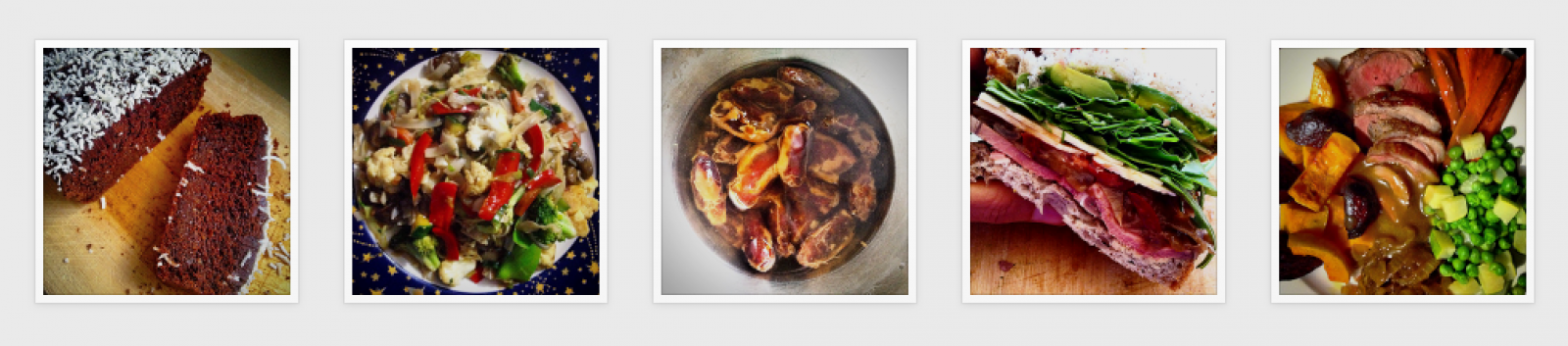
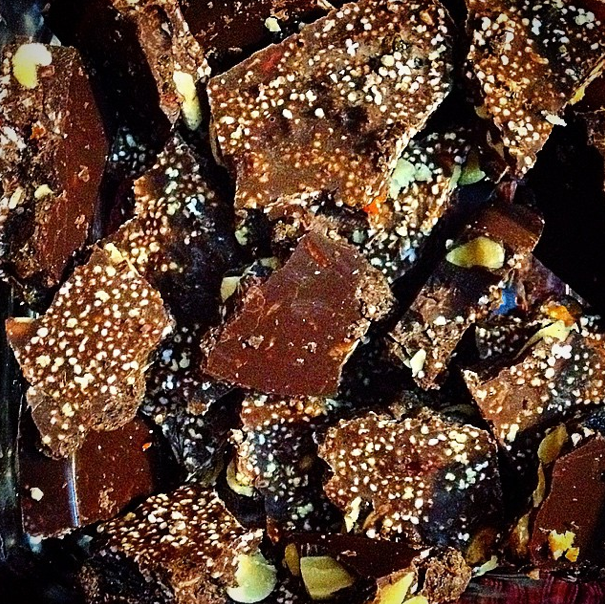
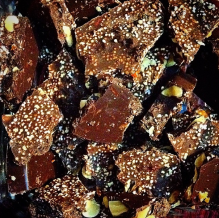
Chocolate Bark: I pour the chocolate onto baking paper on a plate, or into a dish ‘oiled’ with coconut oil then sprinkle anything and everything into it, like: chopped nuts, seeds, goji berries, shredded coconut, amaranth puffs… go nuts!
food fervour

Chocolate ‘Bark’

Milk Chocolate: I recently decided to try adding (organic) milk powder to a chocolate mix and I thought it was so good that I pretty much ate the whole test batch in one go! (This is not to say everyone will agree.) Add approximately half the amount of milk powder to the fresh chocolate mix (so ¼ cup or two tablespoons per the measures I provided above, and mix VERY well (it will thicken quickly) to dissolve the powder as well as possible, then set or add stuff as you wish.

Please feel free to share any amazing combinations you concoct!

food fervour

Strawberries dipped in raw chocolate

Cacao Beetroot Cake

As far as I’m concerned, the more veggies you can get in, the better. And this cake, well, unless you’re extremely picky, you wouldn’t know there’s a vegetable in it. I haven’t made it for ages and, true to form, I’ve altered the original recipe yet again.

I had leftover rice and almond milk pulp to use up, and for once I decided to go with spelt flour instead of the usual (heavier, gluten free) buckwheat. This recipe is almost fool-proof so if you wanted to use a plain gluten-free flour go for it; I can pretty much guarantee it will still turn out.

The biggest difference for me this time however was using raw beetroot. The recipes usually call for ‘cooked mashed beetroot’ but you see, apart from now owning a Thermomix that will virtually pulverise the tough root veggie, I concluded that it would cook during its 40-50 minute sojourn in the 180ºC oven environment. It seems to have worked.Food Fervour

So for this amazingly moist healthy ‘choccy’ cake, I used: 1 medium-large beetroot, 1 teaspoon vanilla essence, ¾ cup coconut sugar, ¾ cup coconut oil, 2 eggs, 1¼ cups spelt flour (actually I used ½ cup almond & rice milk pulp + ¾ cup spelt, and it worked) 1 teaspoon baking powder (bicarb soda), ½ cup (or a fraction more!) cacao powder, ½ teaspoon sea salt and ½ teaspoon ground nutmeg.

beetrootFirst you’ll need to grate your beetroot (I hope you’re not wearing white?!) unless you have a Thermomix or other very high powered blender or food processing appliance (because I buy organic beets I didn’t peel it). Thermie users, I chose speed 5-6 for about 15 seconds, stopped to scrape down the bowl & repeated once more.

For the manual cooks, you’ll need another bowl to thoroughly blend the moist ingredients (vanilla, sugar, oil and eggs) then add the beetroot to the mix (or vice versa). Thermomixers can add the ingredients directly to the bowl with the beetroot in it and blend for 20 secs at speed 5-6. Scrape down afterwards.

Now, I know most chefs & cooks prefer the dry goods to be pre-mixed but I usually never do this because I’m lazy: I hate creating more washing up (with extra bowls). I prefer to substitute this action with prolonged ‘elbow-grease’… in other words, add all the ingredients individually then mix the crap out of that cake batter until it can’t possibly be anything but well-blended. With a wooden spoon this equates to a fair bit of energy consumption and perhaps some lactic acid build-up in the muscles of your stirring arm. With electric beaters (does anyone even own them anymore?) food processors or Thermomixes it’s a piece of cake (excuse the pun). Chuck in all the remaining ingredients (flour, bicarb, cacao powder, salt & nutmeg) then mix, mix, mix! (Thermies, a couple of 20 second hits around speed 5-6, with some scrape downs, should do fine).

Don’t panic if your batter seems too liquescent (runny)… that’s exactly how mine was. Believe me, it solidifies as it bakes but the result is ridiculously moist! Pour into a greased, lined loaf tin and bake in a moderate oven (180ºC) as previously mentioned, for 40-50 minutes. A knife or skewer inserted should come out cleanly when it’s done. Let it cool for about 5-10 minutes before turning it out of the tin… because its so moist you’ll risk it falling apart while hot.Food Fervour

Now this could be enjoyed on its own because it is so moist but I pimped mine up with some of my homemade chocolate ganache (find that recipe here) and shredded coconut.

Yarrrrrm!


3 Ingredient ‘Chocolate Ganache’

Ok so how I came across this one was …kind of like the movie ‘Sliding Doors’. And I realise that won’t mean anything to those who haven’t seen it. But basically, it was by accident, and yet also a ridiculously close ‘shave’. Let me explain:

When I began making ‘raw cookies’ about a decade ago (before they became the energy/protein balls or raw truffles we all know today) I soaked dates. Yep, just that. I soaked dates, as the basis for these healthy raw food treats. You would blend them up (but because I never had a blender, I just chopped them over and over again until they resembled something a food processor or blender might spit out) then mix milled or chopped nuts, seeds and whatever else into them before the messy part of the job: the hand-rolling and coating in   desiccated coconut or again, nut meal.Food Fervour

It was when I came across a recipe that included cocoa (yes, before cacao powder went ‘mainstream’) that I realised soaked dates mixed with cocoa could make a kind of (weird) chocolate substitute. But this is where the train doors slid shut…. and I forgot about it.

…Until last year sometime, when, after making another slightly dry (I admit!) gluten free cake that I knew would benefit from some kind of moist topping (but what to make without heaps of processed sugar?) the train doors automatically opened and I soaked some dates. It worked perfectly – for ME: I realise chefs and food critics would turn up their noses, but I’m not about perfection (at the cost of health).. I’m about clean, unprocessed Imitation & Adaptation!

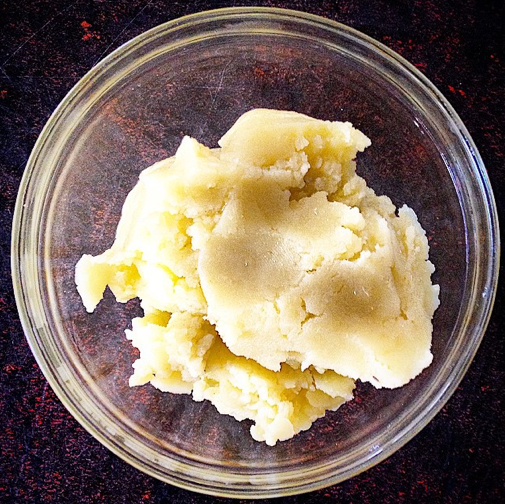
This is extremely easy but you’ll need to allow more time: the longer the dates soak, the better. In fact, if the dates are well soaked and chopped, you don’t even need a blender for this recipe; some old fashioned elbow grease (mixing by hand) will work. Oh and make sure there are no seeds in them!

One cup of dates (I use Iranian, I imagine Medjool would work even better, and may not need to soak for long – if at all. Please let me know how this goes if you try this!) will easily thickly coat a loaf-sized cake, with some to spare.

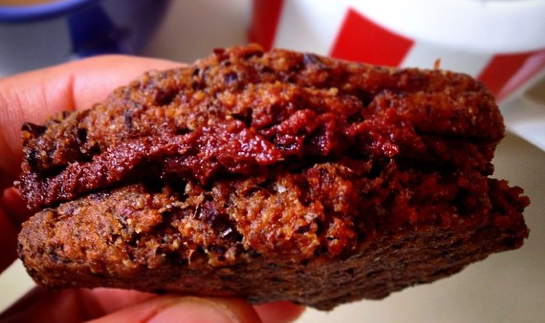
Food FervourDrain the water from the dates (I actually keep this to use as a liquid sweetener in other creations: waste not, want not!) and throw them in a powerful blender with 2 heaped tablespoons of cacao powder (add more for a stronger dark chocolate flavour) and 2 tablespoons liquefied coconut oil. You will need to blend & scrape numerous times (Thermomixers, I performed about 4 rounds of 15 seconds, increasing from speed 5 to 9) but the result is worth it: a rich, thick, chocolatey ‘ganache’ that you can top cakes with, fill biccies with, or even eat on toast like Nutella (if you’re desperate enough)! If you really want to you could press the ganache through a strainer to ensure a smoother product, but for my money, what’s the point in removing all that extra natural fibre?

Food Fervour

‘Ganache’ used as a biscuit filling

There’s heaps of room to experiment too: powdered spices or essences could alter the result… Vanilla or peppermint essence? Cinnamon? Even a touch of chilli powder? I think I might try to explore a salted caramel version so… stay tuned for that!

Quick Chicken Mushroom Stew

I LOVE a quick meal. Usually I’ll spend more time on Google looking for a recipe (to adapt!) than I’ll end up spending on the actual cooking process.

Last night I had two boneless chicken thighs to thawed and knowing my button mushies were only days away from turning funky, I searched “chicken mushroom recipes” and found a great, easy recipe on BBC Good Food (here’s the link to the original recipe).Food Fervour

Because I didn’t have all the required ingredients, and because I prefer a higher vegetable content in my meals anyway, I made some changes. (What’s new?!) I used the following:

2 (large) boneless diced chicken thighs, about 1 heaped tablespoon of cornflour, 1-2 tablespoons coconut oil, about 1 heaped tablespoon diced bacon, 1-1½ cups roughly chopped button mushrooms, 250mls chicken stock, approximately 1 tablespoon rice wine vinegar, 1 large chopped shallot, 1-1½ cups broccoli florets, 1 large thickly chopped zucchini.

While half of the coconut oil heats up in the frypan (over medium heat) coat the chicken in the cornflour. (You can do this one of two ways: the sustainable but messy method is to put them together in a bowl and use your hands to coat the chicken, or you could pop the meat & flour in a plastic bag, seal it, then jiggle the contents around until the job is done. I only chose the latter this time around because I had a plastic (food) bag I was about to dispose of.) Chuck the contents in the frypan and cook until the chicken is sealed and browned. Remove from the pan.

Add the rest of the coconut oil, the bacon and the mushrooms and cook, stirring, until the mushrooms soften. Pour in the stock and vinegar, scraping any cornflour from the frypan base and mix it through the liquid (the meagre amount of cornflour used in this recipe means the stew won’t be ‘thick’ in texture). Bring the chicken back to the mix and cook for about 10 minutes, stirring occasionally. Add the shallot, broccoli & zucchini and cook until the broccoli has turned a brilliant green (brighter than it was when raw) – no more than 5 minutes or you risk overcooking the greens. And that’s just no good!

Serve immediately, seasoning if you wish. This will feed two not-so-hungry people but I imagine it would satisfy the ravenous if served over rice. Because I felt like being ‘starchy-carb-free’ at the time, I managed to inhale the entire dish …by going back for seconds 😉 Umah!


Sustainable Eating

Let me just say, from the outset, that this may sound weird to most: I just got excited about making beef stock.

food fervourWell, that’s not exactly true. I have thought of jumping on the ‘bone broth’ wagon for a little while now, but only grabbed my grass-fed cow-parts a couple of days ago. Via a recipe on Jo Whitton’s old Quirky Cooking website, I prepared it and left it to simmer on the stove for almost 24 hours. Er, yes, even when I vacated the house & overnight while sleeping… (I know, a bit of a dodgy move) But now I have 3 litres of nutritious, gut-healing broth.

The exciting part is, I feel great knowing I’m using parts of the animal that a vast majority of people waste. Now I’m no saint (because offal & sweetbreads I just will not be able to manage) but considering I don’t usually consume a lot of meat anyway, I feel like I’m “doing my part” for the environment …and the cows. (Ok, so I’m nowhere near as virtuous as the Vegans and Veggos…)

food fervourWhat made me super excited however, was discovering there was more than just a few litres of broth in this process: there was lard. Well, not exactly; having never used it before, I’m not sure what I’ll do with it…

What I meant to say was beef. Slow-cooked (braised) beef, from the stock bones. So not only did I have lots of broth, but also a substantial amount of protein left to eat. Meals for DAYS! That means my $8 for 2 kilos of cow bits has also saved me a fair bit of dosh.

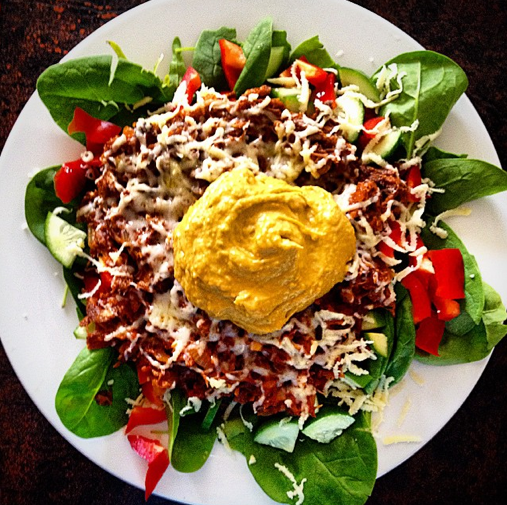
The ready-cooked (falling-off-the-bone, melt-in-your-mouth) meat just needed a ‘theme’ and from the moment I saw & felt its texture, I knew I wanted Mexican. So all I had to do was fry up garlic, onion, spices, add the tomato passata, and some of my fresh broth before adding in the ‘shredded’ meat, to warm & soak up the flavours.

food fervour

Mexican Shredded Beef with grated cheddar & tomato guacamole on a bed of baby spinach, cucumber & capsicum

Making a quick guacamole in the meantime, my Mexican Shredded Beef salad dinner was ready in a matter of minutes. (Alright ….discounting the fact that it took nearly 24 hours to cook the meat in the first place….) And I have enough left for two more meals. I think that’s called “value for money”. And maybe also “sustainable eating” 😉

Cacao Blueberry ‘Ice Cream’

food fervourIn case you haven’t gathered by now, I’m a bit of an ice cream fan. I used to be crazy for it and, while I can still ‘slide’ back into the habit of buying commercial stuff (whether it be a small tub from the supermarket, or a few scoops from a gelati shop) on the odd occasion, I’ve become pretty well disciplined to experiment at home when the desire arises.

It’s actually quite surprising how easy it can be. If you have nuts (& a range of spices) in the pantry, a heap of ‘stuff’ in the freezer and a very powerful blender (mine’s a Thermomix) you can have ice cream in minutes; ice cream will be way better for you than any mass-produced product out there and that should easily satisfy a ‘craving’.

I’ve come across a wide variety of recipes for ‘alternative’ ice creams with the help of Google, so if you want to experiment further do a little research on the net. The most astonishing recipes I came across were for vegan ice creams made entirely from nuts… which really did work! Fat is the key to ice cream however, having said that, some fruits (particularly banana and mango) when frozen thicken beautifully in the blending process.

Drawing on these ideas, along with some others I’ve gained through the Thermomix community, I created this no-added-sugar “ice cream” with a handful of all-natural – mostly frozen – foodstuffs. I have an almost permanent store of frozen fruit and yoghurt cubes in my freezer, which means I’m well prepared to make ice cream at the drop of a hat. Now, if you don’t like yoghurt you can try freezing cubes of coconut milk (vegan option) or perhaps even ordinary cow’s milk (I’ve never tried this), but creams (dairy especially) tend to split when frozen so they’ll affect the texture of your finished product.

food fervour

ready-to-freeze yoghurt

Forewarning: don’t expect the smoothest ice cream texture (because of the extra, natural, ‘great-for-your-gut’ fibre in it) and it definitely isn’t as sweet as your commercial counterparts…

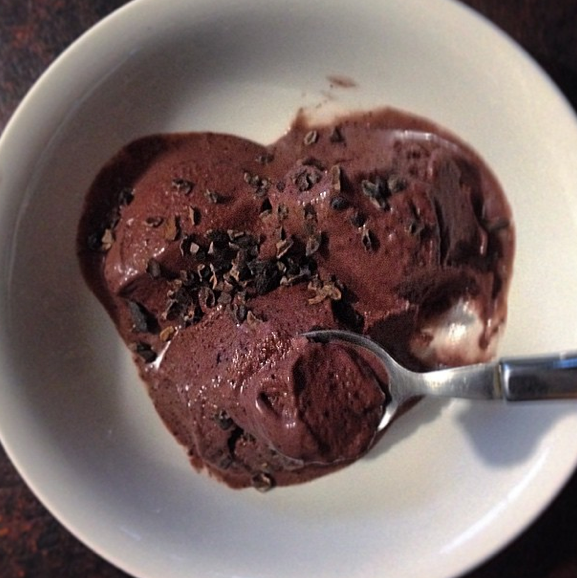
Armed with 20gm hazelnuts, 4 dates, 1 frozen banana (cut into chunks), ½ cup frozen blueberries, 100gm frozen yoghurt cubes (approx 8) 1 heaped tablespoon of cacao powder and 1 teaspoon vanilla paste (optional) I created a taste sensation that could have served 2 people… but I ate the whole lot!

Place the hazelnuts and dates (try more than 4 if you are a real sweet tooth) in a high powered blender and blast until the nuts become ‘meal’ (Thermies: 10 seconds, speed 9-10)

Scrape down the sides of the jug/bowl then add the rest of the ingredients: banana, blueberries, yoghurt/milk cubes, cacao & (optional) vanilla. Blend until smooth. This may take 2-3 rounds: repeat blending, stopping, scraping down and mixing a little by hand. (Thermies: I started around Speed 5 and worked my way up to Speed 9 over a 30 second period, stopped, scraped down & mixed then hit it again at Speed 9 for another 30 seconds)

It should be solid enough to dish out in balls that look like huge scoops of ice cream. I topped mine with cacao nibs (coz I love chocolate chip ice cream) and devoured it in a matter of minutes.

food fervour

Believe it or not, this is a ‘kale’ (& mango) ice cream, I made from a green smoothie base. 10/10 for imagination?

Let me know how you go, and please feel free to share your variations or own personal experiments 🙂

Cravings & Improvisation

I once heard somewhere that cravings can be your body’s way of alluding to a lack of certain nutrients: for example, a desire for ice cream could mean you need calcium. food fervourNice thought, but moreover, great excuse to abuse yourself! If you need calcium, won’t a glass of milk or handful of sesame seeds suffice? Nope!

Cravings can really only be tackled psychologically. You either talk yourself out of it (which may increase the danger of its return, more powerful than before) or you cave. Or, you could try doing what I have taught myself to do. It works hmm, maybe 90% of the time? And that’s a pretty good strike rate for someone who can really lack willpower when it comes to food.

It only takes a few minutes of focus; to analyse what exactly it is you want from the particular food or drink you are craving. What ‘characteristics’: flavour, texture, temperature. Savoury or sweet? Crunchy or creamy? Warm or cold? Moist or dry? Sometimes this very process can diminish the craving, but at the very least it buys you time: time to avoid the instant (& usually poor quality) gratification option.

I used to crave ice cream after dinner. But I can’t have the stuff in the house because – apart from knowing how rubbish it is for me – it wouldn’t last 24 hours. I can – and have – demolished a tub in one sitting. But by putting a little thought into it, I worked out that it was actually the cool, moist, sweet creaminess that my taste buds craved, not necessarily ice cream. So I turned an ice cream habit into a Greek yoghurt with fruit and/or nuts, and/or cacao habit, which I’ve actually blogged about previously: You Don’t NEED Ice Cream

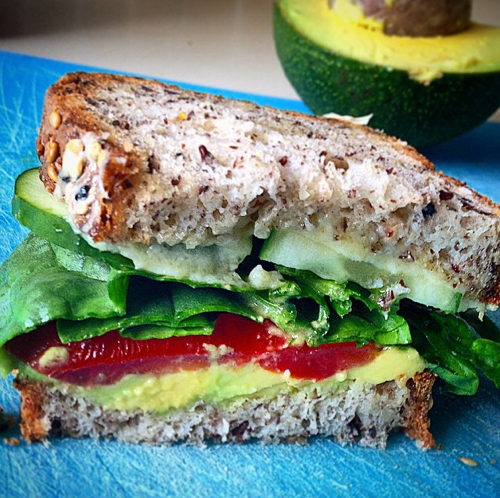
food fervourToday’s lunch was the result of a little bit of analytical thought as well. I had cheese on my mind. And avocado. Now I’m a fan of cheese on toast (in fact, it’s a ‘swap-out’ I have used to satisfy a sausage roll craving a couple of times in the past, believe it or not – warm, savoury) but I wasn’t so “one-eyed-and-desperate” enough to settle on such a simple meal, when I could easily pack more nutrients (& fibre) into it by adding some extra elements.

So my toasted cheese and avocado sanger became a toasted cheese, avocado, tomato, cucumber & baby spinach sandwich. That totally satisfied me.


The Meaning of Lunch

I have no idea why the word ‘Lunch’ brings up a particular meal description for me. Just like certain smells and songs have the power to evoke memories, for some reason, the word ‘Lunch’ to me means: a ham sandwich and cold chocolate milk.

I have, of course, eaten a huge variety of foods for ‘the midday meal’ in my 44 years, but for some strange & unknown reason, the ham sandwich, the chocolate (actually, Akta-Vite) milk and the time & place I consumed these, seems to have somehow forged an attachment to this one word.food fervour

Mum used to make our lunches for the most part. She would of course try to make us take responsibility ourselves, but ….lazy kids… say no more! Sandwiches were often the quickest, easiest meal and in that day-and-age of limited nutritional education, it stood to reason that these were what we were mainly fed.

Living in the tropics as well meant food preservation was a bit of an issue, but Mum got around that one with the help of the freezer. Making the lunches at night to freeze was also a time-saver in the mornings. Pack and go.

So my ham sandwich (cut in half horizontally, not diagonally, because it fit better in the lunchbox as two rectangles rather than triangles) and my Akta-Vite thawed out in time for ‘Big Lunch’. (In Australia, morning recess and lunchtime are known as ‘Little Lunch’ and ‘Big Lunch’. It’s fairly easy to work out, yes?) We would often eat most of our packed foodstuffs at ‘Little Lunch’ as well, leaving the morning tea fruit or whatever for the midday break.

The particular memory or image I have of myself consuming this specific menu is in my junior years at high school (so would’ve been twelve or thirteen years old). Ours was a brand new state school and there were as yet few places to sit and eat comfortably.

A couple of us are sitting cross-legged on some concrete at the rear of one of the classroom blocks and I have my lunchbox in my lap, and I’ve already vigorously shaken the plastic drink bottle full of the still-partially-frozen Akta-vite, ready to drink. I bite into the soft white bread sandwich, enjoying the saltiness of the ham chewing and swallowing before taking a swig of the sweet cold choccy milk. Ahhhh. Why do they go together so well?

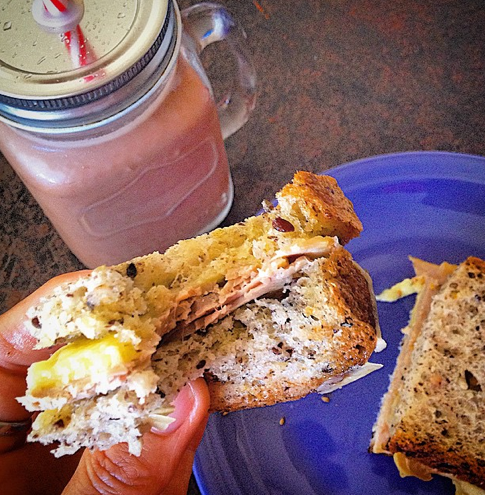
While I’d now consider this kind of meal a bit of a ‘fail’ in the nutrition stakes, every now and then I decide to treat myself to those ‘sensations’. Today was one of those days. But the end product was slightly different; slightly healthier thanks to my swap-outs.Food Fervour

Instead of mass-produced ham, I used a nitrite-free product. I replaced the white bread with a high fibre gluten-free version; my pure homemade butter in place of margarine (ugh!) and instead of the sugar-loaded (but ‘mineral-dense) Akta-Vite, I mixed cacao and a little maple syrup with my fresh, homemade rice & almond milk. Admittedly, I broke from tradition and added some melted tasty cheddar to the sanger today (see pic)…. who doesn’t love a ham ‘n’ cheese “toastie”?!

Craving satisfied, without the added stress on my internal organs. But I will want a heap of veggies for tea tonight! 😉